If persecution is woven into the Church’s identity, then the Church’s response must be shaped not by fear, ideology or political instinct, but by Christ Himself. The question is not simply how believers survive hostility, but how they embody Jesus within it. Scripture does not leave the Church without a pattern. The life, death and resurrection of Christ form the believer’s faithful endurance.
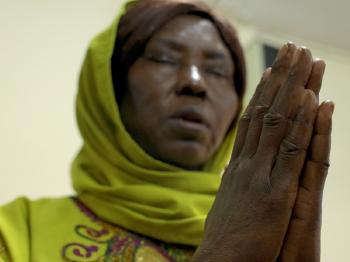
A young believer in Ghana. Hostility may shape the moment, but Christlikeness shapes the response
Part One of this series focused on understanding persecution, why it occurs, how Scripture frames it, and why it has accompanied the Church from its earliest days. Having explored its theological roots, we now turn to the question of response: not simply how believers endure suffering, but how they bear witness within it in a manner shaped by Christ Himself.
Christ the persecuted and the pattern for His people
Persecution is first and foremost Christological.
Before it was the Church’s experience, it was Christ’s own. Isaiah foretold the Servant who would be “despised and rejected… a man of sorrows and acquainted with grief” (Isaiah 53:3, ESV). In the Gospels, Jesus is misunderstood by His family (Mark 3:21), opposed by religious authorities (John 11:53), abandoned by His disciples (Mark 14:50), falsely accused (Matthew 26:59-60), and executed under imperial authority.
Yet He interprets His suffering not as defeat but as obedience to the Father and love for the world (John 10:17-18).
When He tells His disciples, “If they persecuted Me, they will also persecute you” (John 15:20, ESV), He is not predicting misfortune; He is defining participation. The Church’s suffering is derivative. It flows from union with Him.
A Barnabas-funded aid distribution in Egypt. Faithfulness to Christ may bring suffering, but we do not walk this road alone
This is why Paul can write that believers are “heirs with Christ, if indeed we suffer with Him so that we may also be glorified with Him” (Romans 8:17, ESV). Persecution, then, is not merely sociological pressure; it is communion with the crucified Messiah.
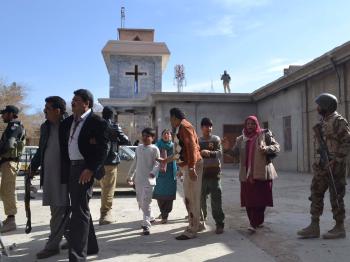
This participation is not theoretical. When Christians in Egypt gather to worship under the shadow of past church bombings, they do so in conscious remembrance of Christ who conquered death. When Iraqi Christians returned to the Nineveh Plains after the devastation wrought by Islamic State (IS, ISIS, ISIL, Daesh), rebuilding homes and sanctuaries marked by ash and rubble, they bore witness to resurrection hope inscribed in scarred stone.
Christ is not distant from such suffering. He is present within it.
The Apostolic Church: Persecution as mission catalyst
The book of Acts reveals that persecution did not halt the Church’s mission; it propelled it.
After Stephen’s martyrdom, “a severe persecution broke out against the church in Jerusalem… So those who were scattered went on their way preaching the word” (Acts 8:1-4, CSB). What appeared to be fragmentation became multiplication. The Gospel crossed ethnic and geographic boundaries through displaced believers.
Read more: What is it like to live as a Christian in Egypt?
This pattern finds a striking echo in the contemporary realities of the Middle East and North Africa (MENA) region.
The displacement of Syrian Christians through war has led to new diaspora congregations across Lebanon, Jordan, Europe and beyond. Sudanese believers scattered by conflict have carried their faith into refugee camps and urban centres, forming prayer gatherings in fragile spaces. Much like the early Church, exile has become unexpected mission.
Theologically, this reflects the sovereignty of God. What hostile powers intend for silencing, God sovereignly ordains for salvation (Genesis 50:20). The Church does not seek persecution, but neither does it assume that suffering negates divine purpose.
The Sermon on the Mount: Blessed are the persecuted
Jesus’ declaration in Matthew 5:1012 remains startling: “Blessed are those who are persecuted because of righteousness, for the kingdom of heaven is theirs.” (CSB)
Blessed, not because pain is good, but because allegiance to Christ situates believers within the reign of God. The reward is not immediate relief but participation in an eternal kingdom.
An elderly believer in desperately impoverished Cuba. Faith does not promise instant reward, but it gives strength through pain 
In societies where religious identity is intertwined with national belonging, conversion to Christianity may be interpreted as betrayal. In parts of North Africa, converts from Islam may face familial rejection or social isolation. In such contexts, the Beatitudes become deeply embodied. Those cast out of earthly households are received into the household of God (Ephesians 2:19).
The Church must teach this theology carefully. Persecution is not romanticised; tears are real. Yet Jesus reframes suffering within a horizon of glory. He anchors endurance in promise.
The cross as the Church’s political theology
Christians often live as minorities navigating complex political landscapes shaped by nationalism, sectarianism and historical wounds. In such contexts, the temptation may arise either toward fearful withdrawal or toward defensive alignment with coercive power.
The cross rejects both.
Christ did not seize political force to defend Himself. Nor did He retreat into silence. He bore witness before Pilate: “My kingdom is not of this world” (John 18:36). His authority was cruciform, revealed through sacrificial love.
Read more: Why are Christians persecuted? A missiological and ecclesiological reflection
The Church’s credibility has often rested not on dominance but on service. Christian hospitals in Jordan and Lebanon, schools in Egypt, humanitarian ministries in Iraq and Sudan – these are forms of cruciform presence. They proclaim Christ through compassion.
Where believers respond to hostility with forgiveness, such as families of Egyptian martyrs publicly affirming their faith after acts of terror, the Gospel becomes luminous. The world witnesses a power that transcends vengeance.
The letters of Peter: Identity in exile
The book of 1 Peter was written to believers living as social outsiders. Peter addresses them as “a chosen race, a royal priesthood, a holy nation” (1 Peter 2:9, CSB), language originally applied to Israel. Their marginality does not negate their dignity; it intensifies it.
He urges them to:
- live honourably among unbelievers (2:12)
- submit wisely within societal structures (2:13-17)
- endure unjust suffering with Christlike patience (2:21-23).
This counsel resonates strongly in contexts where Christians must navigate citizenship faithfully while holding ultimate allegiance to Christ.
The Church elsewhere often walks a delicate path, contributing constructively to society while maintaining theological integrity. The call is neither rebellion nor assimilation, but faithful presence.
Peter roots endurance in Christ’s example: “When he was insulted, he did not insult in return… but entrusted himself to the one who judges justly” (1 Peter 2:23, CSB).
Entrustment is the heartbeat of perseverance.
Revelation: The slain Lamb reigns
No Biblical book speaks more powerfully to persecuted believers than Revelation. Written to churches under imperial pressure, it unveils a cosmic perspective: the Lamb who was slain stands at the centre of the throne (Revelation 5:6).
Power is redefined. Victory belongs not to the beastly empires of the age, but to the sacrificial Lamb.
A church building in Egypt. Empires rise and fall, but the quiet faithfulness of God’s people endures
For Christians in regions where authoritarianism, militancy or instability threaten security, Revelation offers both realism and hope. It does not deny suffering; it situates it within a larger drama. Martyrs cry out for justice (Revelation 6:10), and God promises ultimate vindication.
The small prayer gatherings in Iranian house churches, the quiet faithfulness of believers in Algeria or Sudan, these echo the Revelation vision: worship rising from contested ground.
The global body and shared suffering
Paul’s metaphor of the body (1 Corinthians 12:26) demands that persecution never be localised. If one member suffers, all suffer.
For the wider Church, understanding must move beyond sentiment. It includes persistent prayer, theological humility and practical support. Western or majority churches must resist speaking for persecuted believers without first listening to them. Many Christians do not ask for rescue from suffering as much as they ask for steadfast companionship in it.
Their theology, forged under pressure, often carries a clarity and depth that challenges comfort-shaped Christianity elsewhere.
Christ at the centre
Ultimately, persecution is not about Christianity’s survival as an institution. It is about fidelity to Christ. The Church in the Middle East traces its lineage to the earliest centuries, to Antioch, Alexandria, Carthage and beyond. These communities have endured waves of empire, conquest, marginalisation and renewal. Their continued witness testifies to the sustaining presence of Christ.
He is the Shepherd who walks among the lampstands (Revelation 1:13).
He is the One who holds the keys of death and Hades (1:18).
He is Emmanuel, God with us, even in narrow alleyways and fragile sanctuaries.
Persecution cannot extinguish the Church because it cannot dethrone the Lamb. Where believers forgive, serve, endure, rebuild, pray and worship amid uncertainty, they proclaim a Gospel stronger than fear. Their lives become living exegesis, interpretations of the cross and resurrection written not in ink, but in faithfulness.
And in the deserts and cities of the MENA region, as in South Asia and beyond, Christ continues to gather His people, often quietly, sometimes painfully, always sovereignly, until the day when suffering gives way to sight and the persecuted Church joins the triumphant chorus:
“Salvation belongs to our God, who is seated on the throne, and to the Lamb!” (Revelation 7:10, CSB).